
The Strategy Breakdown
Lifecycle Marketing 101
Lifecycle Marketing Strategies: The Ultimate Guide to Building Revenue Through the Customer Journey
Lifecycle Marketing
YOUR FREE GIFT
Download your copy of The Ultimate Guide in Creating Your Lifecycle Marketing Strategy
Need Help ?
Please feel free to contact us. We will get back to you with 1-2 business days.
Contact Us
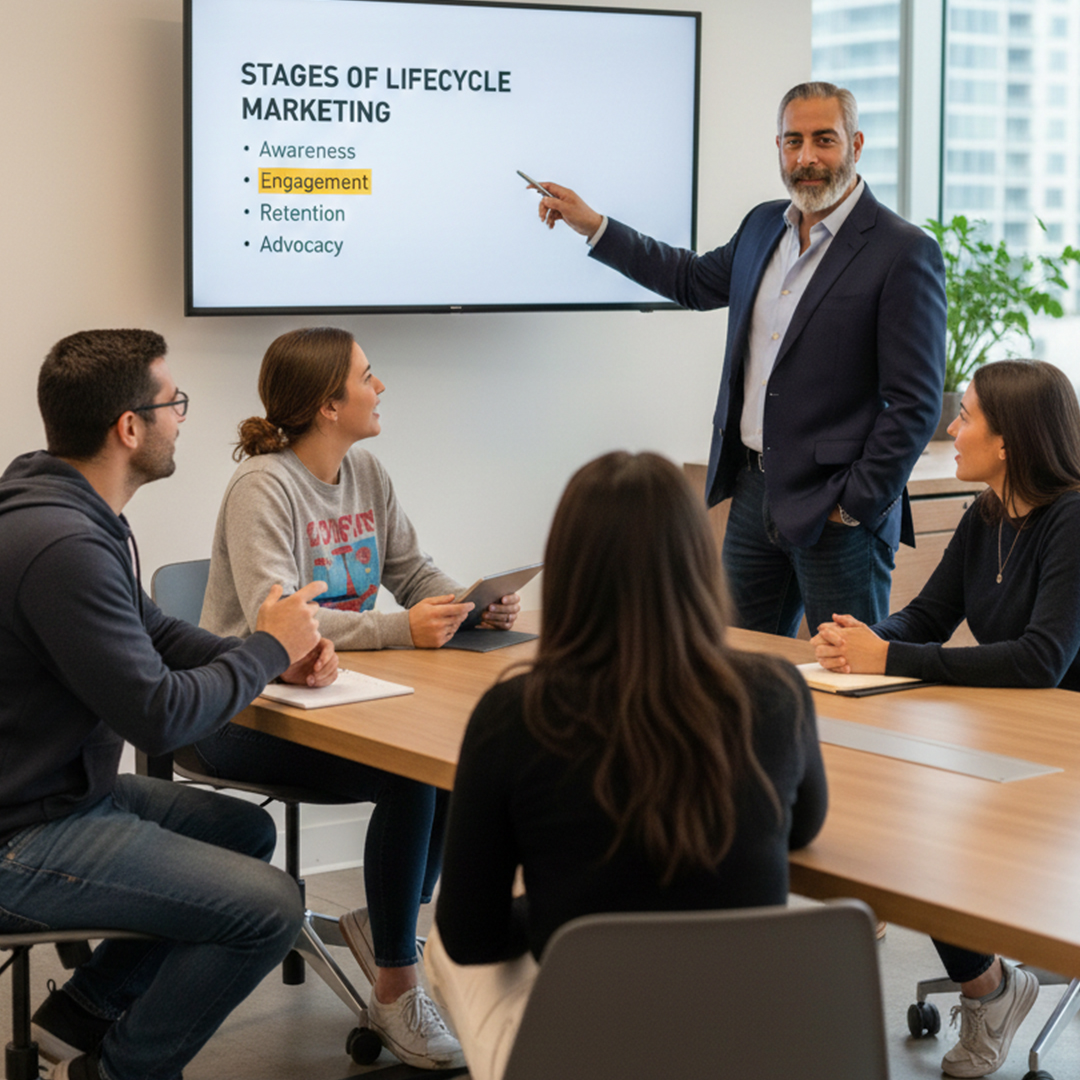
What is Lifecycle Marketing?
If marketing were a relationship, lifecycle marketing would be the long game, not the first impression. It is the difference between a quick handshake and a lasting partnership. In a world where customers are overwhelmed with choices, ads, and noise, lifecycle marketing gives brands a way to speak with intention at every step of the customer journey, from the first curious glance to years of loyal advocacy.
Lifecycle marketing is not about chasing transactions, it is about building momentum. Think of it like nurturing a garden instead of just harvesting crops. You prepare the soil, plant the seeds, water them, protect them, and over time, the harvest becomes bigger and more predictable. That is exactly what lifecycle marketing does for your revenue, creating a pathway for loyal customers.
In this guide to lifecycle marketing, we are going deep into what lifecycle marketing really is, how it works, and how you can build a strategy that turns customers into long-term revenue drivers instead of one-time buyers.
At its core, lifecycle marketing is a strategy that aligns your marketing efforts with where a customer is in their relationship with your brand. Instead of blasting the same message to everyone, lifecycle marketing delivers the right message, at the right time, through the right channel.
Imagine walking into a store where the salesperson treats you the same whether you are just browsing, buying your first item, or coming back for your tenth purchase. It would feel awkward, right? Lifecycle marketing fixes that disconnect by adapting communication based on customer behavior, intent, and history.
Lifecycle marketing acknowledges a simple truth, not all customers are equal in intent, readiness, or value. Some are just learning who you are, others are evaluating you, and some are already sold and deciding whether to stick around based on your marketing metrics. Each stage requires a different conversation, a different tone, and a different goal to effectively guide potential customers through the stages of the customer lifecycle.
What are Some Lifecycle Marketing Examples?
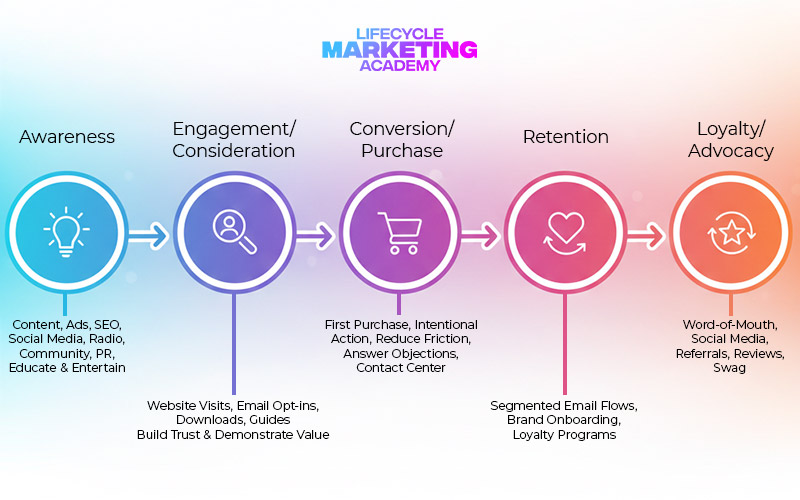
Lifecycle marketing delivers tailored campaigns for each stage of the customer journey—awareness, consideration, purchase, retention, and advocacy—using channel-specific, timely messages to increase loyalty and revenue. Examples include:
- Spotify’s onboarding messages that welcome and engage new users
- Amazon’s product recommendations that encourage upsells and cross-sells
- Netflix’s personalized content suggestions that help retain subscribers
- Sephora’s Beauty Insider program that rewards loyal customers
- Gap’s targeted win-back offers aimed at reactivating lapsing shoppers.
These efforts are coordinated across email, mobile apps, and social media to keep interactions relevant and effective.
Why Lifecycle Marketing Matters in Modern Business
In today’s digital-first economy, attention is expensive and loyalty is rare. Businesses can no longer rely on endless customer acquisition to fuel growth; they must prioritize customer relationships and retention. Platforms get more competitive, costs rise, and consumers become more skeptical. This is where implementing lifecycle marketing becomes a competitive advantage.
Instead of focusing only on how many people you can attract, lifecycle marketing focuses on how many you can keep, grow, and turn into advocates. It shifts your mindset from volume to value. When done right, lifecycle marketing increases revenue without increasing acquisition spend, which is the holy grail of scalable growth.
Lifecycle marketing also builds trust. When customers feel understood and supported rather than sold to, they are far more likely to engage with relevant content throughout the stages of the customer lifecycle. And in a market where trust is currency, this becomes priceless for growth marketing.
Lifecycle Marketing vs Traditional Marketing
Traditional marketing is often campaign-driven, whereas effective lifecycle email marketing focuses on ongoing customer relationships. You launch a promotion, run ads, push emails, and then move on to the next campaign. Lifecycle marketing is system-driven. It is not about what you are promoting this month, it is about how customers move through your ecosystem over time.
Where traditional marketing asks, “How do we sell this product?” lifecycle marketing asks, “How do we support this customer at this moment?” That difference might seem subtle, but it changes everything, from your content strategy to your automation logic to your KPIs.
The Core Stages of Customer Lifecycle Marketing
Lifecycle marketing is built around stages that reflect how customers interact with your brand over time. Let’s break these down in a way that feels practical and usable.
Awareness Stage
This is where the relationship begins. A potential customer becomes aware of your brand, often through content, ads, word of mouth, or organic search. At this stage, your job is not to sell, it is to be useful.
Your content here should educate, entertain, or solve a problem. Think blog posts, social media, videos, podcasts, and SEO-driven content. You are planting seeds for future customer retention, not just harvesting crops. The goal is to make a memorable first impression and position yourself as a credible solution.
Engagement & Consideration Stage
Once someone knows you exist, the next step is engagement. They visit your site, sign up for your email list, follow you on social media, or download a resource. This is where curiosity turns into interest, leading potential customers to engage with your product or service.
Here, your marketing should focus on building trust and demonstrating value. Welcome emails, educational sequences, comparison guides, and case studies all play a role. You are helping them decide if you are worth their time and attention.
Conversion or Purchase Stage
This is where interest becomes action. The customer makes their first purchase or takes a meaningful step that signals intent. But contrary to popular belief, conversion is not the finish line, it is the starting line.
At this stage, clarity and confidence matter most. Your messaging should reduce friction, answer objections, and reinforce that they are making the right decision. Clear product descriptions, transparent pricing, testimonials, and risk reducers like guarantees are your best allies in enhancing customer satisfaction.
Retention Stage
Retention is where real growth begins and is a key component of growth marketing. Acquiring a customer is expensive, keeping one is profitable. This stage focuses on keeping customers engaged, satisfied, and coming back, while also working to personalize their experience through targeted campaigns for each lifecycle stage.
Retention marketing includes post-purchase emails, product education, onboarding flows, replenishment reminders, and customer support touchpoints. It is about making sure the customer actually gets the value they expected, and then some, to encourage them to make a purchase.
Loyalty and Advocacy Stage of Lifecycle Marketing
The final stage is where customers become promoters. They leave reviews, refer friends, share your content, and defend your brand online. This is where your marketing becomes exponential instead of linear.
Loyalty programs, referral incentives, VIP access, and community-building initiatives all live here. At this point, customers are no longer just buyers, they are partners in your growth.
How to Engage Customers at Every Stage
In lifecycle marketing, chart the customer journey from initial discovery through repeat advocacy and tailor each touchpoint accordingly. Deliver individualized messaging across channels and provide meaningful interactions via educational content and how-to guides to spark interest, targeted promotions to aid consideration, smooth onboarding and responsive support at purchase, and rewards or referral incentives to drive retention and advocacy while systematically collecting customer feedback to iterate and improve the program.
Why Lifecycle and Retention Marketing Is the Backbone of Sustainable Growth
Revenue Stability and Predictability
Lifecycle marketing creates predictable revenue because it is built on systems, not spikes, and helps marketers personalize customer experiences. Instead of relying on occasional campaigns to hit numbers, you develop consistent flows that drive revenue daily, leading to improved customer satisfaction.
When you understand how customers move through your lifecycle, you can forecast revenue more accurately, plan inventory better, and invest with confidence. This stability is what separates scalable brands from reactive ones.
Lower Customer Acquisition Costs
When retention and expansion are strong, you do not need to acquire as many new customers to grow, allowing you to focus on your brand advocates and loyal customers. This naturally lowers your blended acquisition cost and increases your marketing efficiency.
Lifecycle marketing also improves acquisition because your messaging becomes more relevant. When your funnel is well-aligned, every new lead is more likely to convert, making your ad spend work harder.
Increased Lifetime Value
The true power of lifecycle marketing lies in its ability to increase customer retention and satisfaction. customer lifetime value. Through upsells, cross-sells, repeat purchases, and subscriptions, you turn one-time buyers into long-term revenue streams, fostering strong customer relationships.
It is like turning a single spark into a steady flame. The longer customers stay with you, the more profitable they become, and the more resilient your business becomes.
Getting Started with Lifecycle Marketing Strategy
Now let’s get practical. Here is how you actually build a lifecycle marketing strategy that works.
Mapping the Customer Journey
Start by mapping out how customers currently move through your business. Where do they first encounter you? What actions do they take before purchasing? What happens after they buy?
Write this out visually if possible. Identify friction points, drop-offs, and moments where customers need more guidance. This map becomes the blueprint for your customer lifecycle management strategy.
Data, Segmentation, and Personalization
Lifecycle marketing runs on data to help marketers optimize their strategies. You need to know who your customers are, what they do, and how they behave at each stage of their journey. Segment your audience based on behavior, not just demographics, to enhance customer engagement.
For example, separate first-time buyers from repeat buyers, high spenders from discount shoppers, and active users from dormant ones. Then tailor your messaging accordingly. Personalization is not about using someone’s first name, it is about understanding their context.
Choosing the Right Channels
Not every channel works equally well at every stage. Email might be perfect for retention but weak for awareness. Paid ads might drive awareness but struggle with loyalty.
A strong lifecycle strategy assigns channels based on purpose. SEO and content for awareness, email and SMS for engagement and retention, paid retargeting for conversion, and loyalty programs for advocacy.
Creating Lifecycle-Based Content
Content should align with lifecycle stages. Educational content for awareness, comparison content for engagement, trust-building content for conversion, and usage-based content for retention.
When your content matches your customer’s mindset, it feels natural instead of intrusive. That is the difference between marketing that gets ignored and marketing that gets welcomed.
Lifecycle Marketing Channels That Drive Results
Email Marketing Across the Lifecycle
Email is the backbone of most lifecycle marketing systems. It is direct, personal, and highly controllable. Welcome sequences, abandoned cart flows, post-purchase onboarding, win-back campaigns, and loyalty emails all live here.
The key is to move beyond batch-and-blast emails and toward behavior-triggered flows. Every email should exist for a reason tied to where the customer is in their journey.
SMS and Push Notifications
SMS and push notifications bring urgency and immediacy. They work best for time-sensitive messages like order updates, limited-time offers, or reminders.
Used wisely, they enhance the lifecycle experience. Used poorly, they feel like spam. Always tie these channels to clear value and respect frequency limits.
Paid Media and Retargeting
Paid media is not just for acquisition. Retargeting allows you to re-engage visitors who did not convert and upsell customers who already purchased.
Lifecycle-based paid strategies often outperform generic ones because they target intent, not just interest. Someone who abandoned a cart is far more valuable than someone who merely viewed an ad.
Content Marketing and SEO
Content and SEO fuel the top of the lifecycle but also support later stages. Tutorials, FAQs, and use-case content are essential for reducing friction and increasing satisfaction, which ultimately helps in increasing customer lifetime value.
Think of SEO as the front door to your lifecycle marketing system, where you attract potential customers. It brings in people already looking for what you offer, which makes every downstream stage more efficient.
Loyalty Programs and Referral Systems
Loyalty and referral systems formalize advocacy, encouraging existing customers to engage others with special offers. They reward behavior you want more of, like repeat purchases and referrals, while making customers feel appreciated.
These programs turn marketing into a two-way street, where customers actively participate in your growth.
Measuring Lifecycle Marketing Campaigns
Core Lifecycle KPIs
You cannot improve what you do not measure in your customer engagement efforts. Key lifecycle metrics include conversion rate, repeat purchase rate, churn rate, average order value, and customer lifetime value.
Each stage should have its own KPIs so you can see where the system is strong and where it leaks, allowing you to engage customers effectively.
Attribution and Customer Path Analysis
Understanding how customers move across channels and touchpoints helps you invest smarter. Attribution models and path analysis reveal which interactions truly drive results in customer engagement.
This prevents you from over-crediting last-click channels and underinvesting in early-stage efforts that make everything else possible.
Tools for Lifecycle Measurement
Platforms like CRM systems, marketing automation tools, analytics platforms, and customer data platforms all support lifecycle measurement.
The goal is not just collecting data, it is turning data into decisions.
Common Customer Experience Mistakes in Lifecycle Marketing and How to Avoid Them
Treating All Customers the Same
This is the fastest way to kill relevance. If everyone gets the same message, no one feels understood. Always segment and tailor.
Over-Automation Without Strategy
Automation without strategy is just noise at scale. Always define the purpose of each flow before building it.
Ignoring Post-Purchase Experiences
Many brands stop caring after the sale, missing the opportunity for successful lifecycle marketing. This is where loyalty is won or lost. Invest as much in post-purchase as pre-purchase.
Conclusion
Implementing lifecycle marketing is not a tactic, it is a mindset that drives an effective lifecycle marketing strategy. It forces you to think in systems instead of campaigns, relationships instead of transactions, and value instead of volume. In a market where competition is fierce and attention is scarce, lifecycle marketing is how you build something that lasts.
When you design your marketing around the customer journey, every message feels more natural, every dollar works harder, and every customer becomes more valuable. That is not just good marketing, that is smart business.
If you want growth that compounds instead of spikes, lifecycle marketing is your blueprint to guide you in optimizing customer interactions.
FAQs About Lifecycle Marketing
1. What is the main goal of lifecycle marketing?
The main goal is to maximize customer lifetime value by delivering relevant messaging at every stage of the customer journey, ultimately creating loyal customers.
2. Is lifecycle marketing only for large companies?
No, small and mid-sized businesses often benefit even more because lifecycle systems allow them to grow efficiently without massive ad spend.
3. How long does it take to see results from lifecycle marketing?
Some improvements, like better retention or conversion rates, can be seen within weeks, while full compounding benefits often appear over several months.
4. What tools are best for managing lifecycle marketing?
Common tools include CRMs, email marketing platforms, marketing automation systems, analytics platforms, and customer data platforms.
5. Can lifecycle marketing work without automation?
It can, but automation makes it scalable. Without automation, lifecycle marketing becomes manual and difficult to maintain consistently.
WHAT MATTERs MOST TO YOU?
Creating a full Lifecycle Marketing strategy can be overwhelming. We get it. Sometimes, it might be easier to baby-step your way into it. Which area would you like to dive into first?